
Mary Sumner House has stood at 24 Tufton Street since 1925. It has survived floods and wartime bombing, welcomed queens and quiet visitors, and served without interruption as the London home of one of the world’s largest women-led charities.
Buildings that last this long tend to have a story worth knowing. This one does.
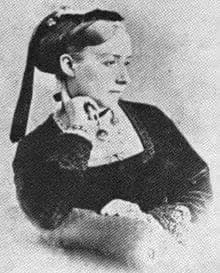
Mary Elizabeth Sumner was born in Lancashire in 1828. Her father was a banker and amateur historian, her mother was a woman of faith who held meetings for local mothers in the family home. These gatherings may have planted the earliest seed of what her daughter would one day build.
Mary Sumner was educated at home, fluent in three languages, and more comfortable in a rectory in rural Hampshire than on any public stage.
She was nearly fifty and a grandmother when she finally acted on an idea she had carried for years. In 1876, she invited the mothers in her husband’s parish in Old Alresford to a meeting at the rectory. Her idea was radical for its time: that women of all social classes should come together as equals, to support one another in raising their children. She was so overcome with nerves that she had to ask her husband to speak in her place. Embarrassed, she invited them back the following week and vowed never to let her shyness stop her again.
The gatherings remained small for nine years until 1885, when an unexpected invitation changed everything. At the Portsmouth Church Congress, the Bishop of Newcastle was due to address a packed session of women churchgoers. He felt that a man had no authority to speak to women about the realities of their lives, so he asked Mary Sumner to speak in his place. Her address on the power of women to change the nation inspired those present to return to their parishes and found groups of their own.

The Bishop of Winchester gave the movement his official backing, and what had started as a village gathering was suddenly something far larger.
The movement grew with a speed that surprised everyone, including Mary Sumner herself. Within seven years, there were over 60,000 members across 28 dioceses, and by the turn of the century, that number had nearly tripled. In 1897, Queen Victoria became a patron, demonstrating to the world that a movement built by women, for women, had earned its place at the heart of the nation.

At 84, Mary Sumner was still touring the North of England, addressing meetings on a schedule that would have exhausted younger women. She spoke at the Royal Albert Hall and lived to see the movement she had started from a Hampshire rectory reach every corner of the British Empire.
Mary Sumner died in 1921, at the age of 92. Four thousand women attended her funeral.
While she never saw this building, a commemorative plaque was laid two years after her death by her daughter, Louisa, in front of over 2,000 members gathered in her memory. Mary Sumner House was built as a tribute to what she started in 1876, and it has been honouring her ever since.
The building on Tufton Street was not the first to carry the name. In 1917, as the First World War came to its close, a Mary Sumner House opened at Dean’s Yard. The first London home for the movement was opened by Princess Christian, daughter of Queen Victoria, and dedicated by the Bishop of London. Eight years later, as the movement continued to grow, a permanent home was needed. The Tufton Street building was funded entirely by donations from Mothers’ Union members and friends around the world, and opened on 21 July 1925 by Princess Mary, Viscountess Lascelles.
Today’s Mary Sumner House was designed by Claude W. Ferrier, an architect whose other commissions include Arsenal Football Club’s Highbury Stadium and stations on the London Underground. He was accustomed to designing buildings that needed to carry weight, and the structure he designed for Mothers’ Union reflects that. Grade II listed and deliberately designed larger than the movement needed at the time, it was a statement of faith in what Mothers’ Union would become.
Beside the entrance, the commemorative plaque reads: “To the glory of God and in grateful remembrance of Mary Elizabeth Sumner, who founded the Mothers’ Union in 1876.”
Mary Sumner House is not a museum. Nearly a century after it opened, the building is still doing what it was built to do: bring people together with purpose. Today, its rooms host meetings and conferences where ideas are exchanged, important conversations unfold, and decisions are made that shape organisations, communities and futures.
The building has outlasted wars, floods, and a century of change. All of it traceable to a single moment. A shy woman in her late forties invited her neighbours to a meeting, and the world answered.
When you choose Mary Sumner House, you’re securing an affordable, high-quality venue while supporting women’s empowerment worldwide. Contact us today for availability, pricing, or to arrange a viewing of our historic meeting rooms.
